 fregatte.de
Play now
fregatte.de
Play now
Radar and AIS: see and be seen
In fregatte.de, the naval browser game set in the western Baltic Sea, there is no all-seeing overview. You see only what your frigate’s radar, AIS and bearings pick up. Each of these sources helps you – and every emission can give you away. This page briefly explains what radar and AIS are at real sea, and then exactly how the game models them.
Radar at sea
Radar (“radio detection and ranging”) sends out short radio pulses and measures how long the echo takes to return. The travel time gives the range, the direction of the rotating aerial gives the bearing. On ships, radar is the main way of spotting other vessels and the coast at night and in fog. Radar only sees what lies in a direct line of sight: islands and headlands cast a radar shadow.
The drawback for a warship: whoever transmits can be heard. Passive receivers (ESM, “electronic support measures”) detect other radars at long range and show the direction they are transmitting from – long before your own radar could pick up the ship.
Radar in the game
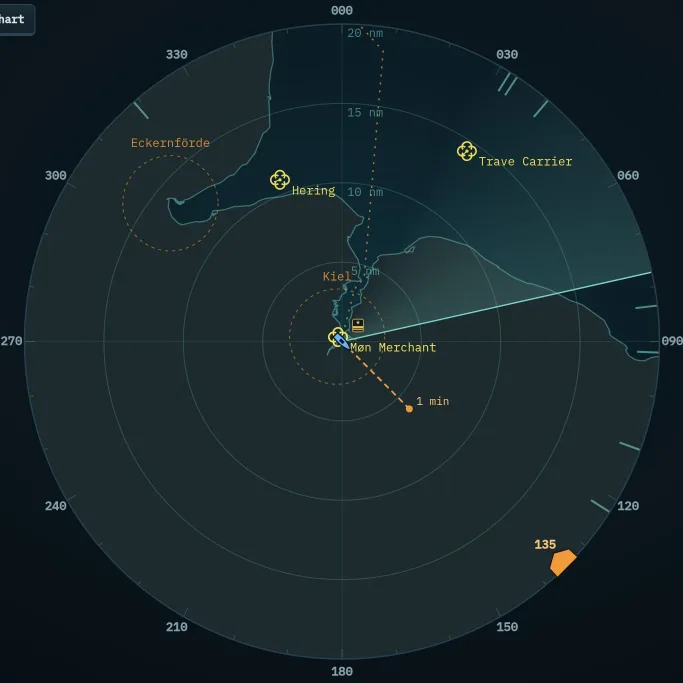
- Range: 30 nm with the basic ship. At the shipyard the sensors line extends it in five levels up to 40 nm.
- Sweep: the beam turns once every 3 seconds. A contact is only updated when the beam passes over it; in between, its last position stays put and fades. A contact not detected for 60 s is dropped.
- What radar gives you: position, course and speed – but no name and no side. Whether an echo is friend or foe is for you to decide when you classify it.
- Radar shadow: if land lies between you and a ship, your radar cannot see it. You can hide behind Fehmarn, Rügen or Bornholm.
- No radar, no firing: weapons need a fresh contact from your own radar (at most 8 s old). With the radar off you cannot fire.
And the flip side: every ship with its radar on appears as a bearing line to everyone within 60 nm – twice as far as your own radar reaches, and land does not screen it.
AIS at sea
The Automatic Identification System (AIS) regularly broadcasts a ship’s name, call sign, position, course and speed over marine VHF. Other ships and shore stations receive the data and show it on their chart or radar. Under the SOLAS convention, large merchant ships and passenger ships must carry AIS. Warships are exempt and usually switch AIS off on operations.
AIS in the game: on means protected
In fregatte.de, AIS is more than a name badge. It is the central protection rule between players:
- AIS on: everyone within 40 nm receives your ship’s name, call sign, position, course and speed every 6 s – regardless of radar and land. In return you cannot be attacked by other players, but you cannot fire either.
- AIS off means ready for action: you appear only as a nameless radar contact, you may fire and you can be sunk.
- Switching takes 30 s. When switching off you are still protected during that time; when switching on you can still be attacked. Anyone who has fired or been hit in the last 60 s cannot switch AIS on.
- Port zones: within 3 nm of every port no weapon works, whatever your AIS setting.
- Exception: enemies of a mission that you or your alliance accepted attack you even with AIS on.
The AI merchant ships – cargo ships, tankers, ferries and fishing boats – always transmit AIS. On the start map and in port you see the public AIS picture: every ship with AIS on across the whole chart, refreshed every 30 s. Ships with AIS off never appear there.
Running silent: bearings
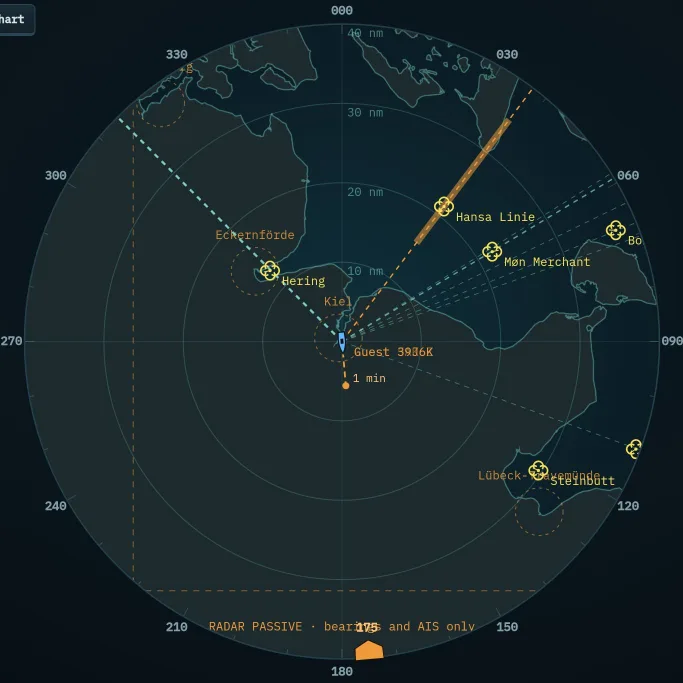
Switch the radar off and it no longer gives you away. You then see ships with AIS, your alliance’s picture and bearings: lines pointing to where another ship’s radar or a radio call comes from.
- No range, but signal strength: strong below 15 nm, medium below 35 nm, weak beyond. The line gets wider and brighter with strength.
- Kind of emission: radio shows as dash-dot (for 5 s after a call). From sensors level 2 the line style also shows the kind of radar: navigation radar (merchant ships), search radar (warships and players) or fire-control radar (a ship that is firing). Fishing boats emit nothing.
- Estimating range: tap a bearing. The “Selected bearing” box shows the drift per minute. Pick an “Assumed speed” (0, 10, 15, 20 or 25 kn); after 15 s the matching range appears as a coloured band on the line. Changing your own course tightens the estimate – the same idea as a real target motion analysis.
Which setting when?
- Radar on, AIS on: safe passage, for example on a transport or escort run without enemies. You see a lot and you are protected.
- Radar on, AIS off: ready for action. You see everything in range – and everyone within 60 nm knows roughly where you are.
- Radar off, AIS off: silent. Ideal for surveillance missions or for sneaking up; you can only fire once you switch the radar back on.
From sensors level 4, other radars detect your frigate only at 85 % of their range. More on contacts, classification and radio is in the guide.