 fregatte.de
Play now
fregatte.de
Play now
Rules of the road: the COLREGs in the game
The Baltic Sea is busy: ferries, cargo ships, tankers and fishing boats. Anyone commanding a frigate there needs to know who gives way to whom. In fregatte.de the real collision regulations (COLREGs) apply – simplified, but on the same principles. The COLREG help shows you what to do in every encounter, and good seamanship counts in the “Best navigator” ranking.
What are the COLREGs?
The International Regulations for Preventing Collisions at Sea, known as the COLREGs or the rules of the road, were adopted by the International Maritime Organization (IMO) in 1972 and have applied worldwide since 1977. Among other things, they set out how power-driven vessels keep out of each other’s way. One principle runs throughout: a vessel that must give way does so early and substantially, and a vessel that stands on stays predictable.
Whether there is a risk of collision at all shows in the bearing: if the bearing of an approaching ship hardly changes (“bearing steady”), you are on a collision course.
The key rules
| Situation | Rule | What to do |
|---|---|---|
| Head-on | 14 | Both alter course to starboard and pass port to port. |
| Crossing, he comes from starboard | 15, 16 | You give way: to starboard or slow down, and pass astern of him. |
| Crossing, he comes from port | 17 | You stand on with course and speed – and act yourself if he does not give way. |
| You are overtaking | 13, 16 | Keep clear until you are well past – on either side. |
| He is overtaking you | 13, 17 | Keep course and speed until he is well past. |
| Fishing vessel | 18 | Power-driven vessels keep out of the way of vessels engaged in fishing. |
In the game, a fishing vessel is any ship whose AIS reports it as one. A contact making no way (below 0.5 kn) is treated like an obstruction: keep clear of it (rule 8, action to avoid collision).
The COLREG help in the game
Select a contact on the radar. The “Selected contact” box has the COLREG help switch (on by default). It works in your browser from the course and speed of both ships – and only for ships you detect yourself.
- CPA: the closest point of approach. It appears when it is closer than 5 nm and at most 30 minutes ahead, red below 1 nm. If the ships are not converging, the box reads “Not closing”.
- Situation and role: with a CPA of 1 nm or more, the box only shows the situation with “Clear – no manoeuvre needed”. Below that it names your role – YOU GIVE WAY, YOU STAND ON or BOTH TO STARBOARD – with the rule number and advice.
- Bearing steady: if the bearing changes by less than 3° a minute, the box says so explicitly.
- Suggestions: if you have to give way, the help suggests the smallest course change in 5° steps up to 90° (starboard first) and the highest lower speed that open the CPA to at least 1 nm. Tap one to order it.
- Course fan: on the degree ring each course is coloured by its CPA: red below 0.5 nm, orange below 1 nm, green beyond, and grey dashed for courses against the rules (to port). Drag the course marker and dashed lines show the CPA of the new course.
How the AI ships give way
Around 60 AI merchant ships sail between the ports at any time. If a ferry, cargo ship or tanker would come closer than 0.5 nm to a player within 30 seconds, it gives way: it slows to 75 % of its cruising speed and alters course by 20°, usually to starboard. On the radar it then carries a bright dot at the top left of its symbol. Among themselves the AI ships follow the same rules: head-on both turn to starboard, when crossing the one with the other on its starboard side gives way, and so does the overtaking ship. Fishing boats and the ships of an escorted convoy do not give way.
Penalty points: Best navigator
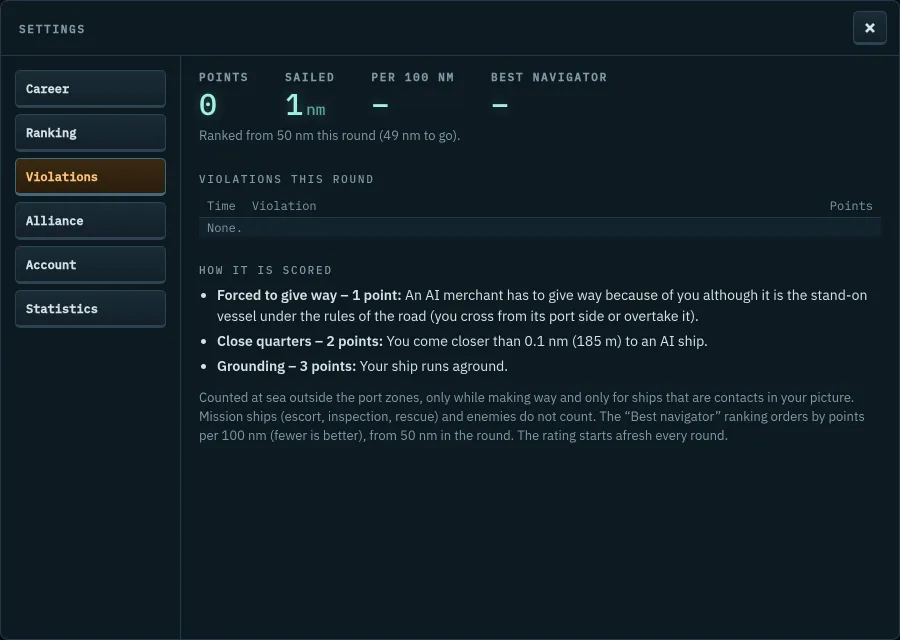
- Forced to give way – 1 point: an AI merchant has to give way because of you although it is the stand-on vessel, because you overtake it or cross from its port side.
- Close quarters – 2 points: you come closer than 0.1 nm to an AI ship.
- Running aground – 3 points: you run onto land or the bottom.
Nothing counts in the port zones, while your own speed is below 0.5 kn, against enemies or against ships of a mission. The “Best navigator” ranking orders by points per 100 nm sailed in the round – fewer is better, ranked from 50 nm. The points cost neither pay nor round points. More in the guide.
The chart in the game is for orientation only. Real fairways, traffic separation schemes and water depths are not shown.